Choosing the best midcap fund can be challenging because several mutual funds invest in the same mid-cap segment but follow different investment strategies, portfolios and risk profiles.
In this guide, we compare three mid-cap mutual funds — HDFC Mid Cap Fund, Edelweiss Mid Cap Fund and WhiteOak Capital Mid Cap Fund — across returns, fund size, risk measures, portfolio allocation, expense ratio and other important factors.
The comparison data is based on the latest available information from ET Money and should be treated as a snapshot because mutual fund performance and portfolio data change over time.
What Is a Mid Cap Mutual Fund?
A mid-cap mutual fund primarily invests in medium-sized listed companies. Under the SEBI classification, mid-cap companies are ranked from 101st to 250th by market capitalisation.
Mid-cap funds sit between large-cap and small-cap funds. They can provide investors with exposure to companies that may have significant room for growth, but they can also experience considerable volatility.
For this reason, mid-cap funds are generally more suitable for investors who have a long-term investment horizon and can tolerate short-term market fluctuations.
Best Midcap Funds Compared
For this comparison, we are looking at:
- HDFC Mid Cap Fund
- Edelweiss Mid Cap Fund
- WhiteOak Capital Mid Cap Fund
All three are classified as equity mid-cap funds.
| Parameter | HDFC Mid Cap Fund | Edelweiss Mid Cap Fund | WhiteOak Capital Mid Cap Fund |
|---|---|---|---|
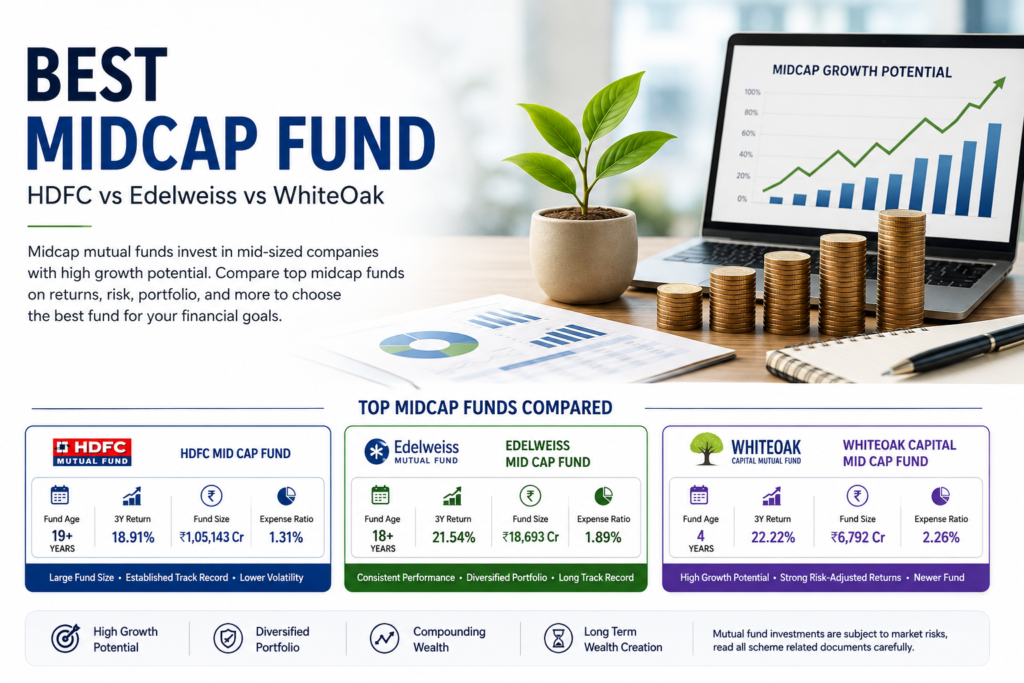
| Fund Age | 19+ years | 18+ years | 4 years |
| Fund Size | ₹1,05,143 Cr | ₹18,693 Cr | ₹6,792 Cr |
| 1-Year Return | 9.86% | 8.65% | 15.23% |
| 3-Year Return | 18.91% | 21.54% | 22.22% |
| 5-Year Return | 20.75% | 19.29% | NA |
| Standard Deviation | 15.34 | 17.66 | 16.87 |
| Sharpe Ratio | 0.83 | 0.87 | 0.91 |
| Beta | 0.84 | 0.96 | 0.91 |
| Sortino Ratio | 0.99 | 1.11 | 1.19 |
| Alpha | 2.33 | 3.50 | 4.07 |
| Equity Allocation | 93.08% | 96.74% | 96.81% |
| Expense Ratio* | 1.31% | 1.89% | 2.26% |
| Exit Load | 1% | 1% | 0% |
*Expense ratio and other fund metrics can change, so investors should check the latest scheme information before investing. ET Money’s current comparison provides the figures above.
1. HDFC Mid Cap Fund
HDFC Mid Cap Fund is the largest and one of the most established funds among the three funds compared here.
The fund has a fund size of approximately ₹1.05 lakh crore and a history of more than 19 years. Its reported 3-year return is 18.91%, while its 5-year return is 20.75% in the ET Money comparison.
Its portfolio has significant exposure to financials, healthcare and automobiles. Some of its leading holdings include Federal Bank, AU Small Finance Bank, Max Financial Services, Balkrishna Industries and Ipca Laboratories.
HDFC Mid Cap Fund may appeal to investors who:
- Prefer an established mid-cap fund
- Want a long operating history
- Have a long-term investment horizon
- Are comfortable with equity-market volatility
2. Edelweiss Mid Cap Fund
Edelweiss Mid Cap Fund has been operating for more than 18 years and has a fund size of approximately ₹18,693 crore according to the current ET Money comparison.
The fund has reported a 3-year return of 21.54% and a 5-year return of 19.29% in the comparison.
Its portfolio’s major sector exposures include financials, capital goods and services. Its listed top holdings include Federal Bank, BSE, Multi Commodity Exchange of India, Marico and Persistent Systems.
Edelweiss Mid Cap Fund may appeal to investors who:
- Want an established mid-cap scheme
- Prefer to evaluate funds based on longer-term performance
- Are comfortable with higher portfolio volatility
- Want exposure to a diversified mid-cap portfolio
3. WhiteOak Capital Mid Cap Fund
WhiteOak Capital Mid Cap Fund is considerably younger than the other two funds, with around 4 years of fund history in the ET Money comparison.
It has a fund size of approximately ₹6,792 crore. Its reported 1-year return is 15.23%, while its 3-year return is 22.22%. The fund does not yet have a 5-year return figure in the comparison.
Among the three funds, WhiteOak currently has the highest reported 3-year return and the highest Sharpe, Sortino and Alpha figures in the comparison. However, its shorter track record means investors should be careful about interpreting these numbers as evidence of long-term superiority.
WhiteOak Capital Mid Cap Fund may appeal to investors who:
- Want exposure to a relatively newer mid-cap scheme
- Are comfortable evaluating a shorter track record
- Want to consider recent performance alongside risk measures
- Have a long-term investment horizon
Which Is the Best Midcap Fund?
There is no single fund that is automatically the best midcap fund for every investor.
The answer depends on what you value most.
If you prioritize long fund history and scale, HDFC Mid Cap Fund stands out.
If you are looking for a combination of longer-term performance and an established track record, Edelweiss Mid Cap Fund deserves consideration.
If you are evaluating recent 3-year performance and risk-adjusted metrics, WhiteOak Capital Mid Cap Fund currently looks interesting, although its shorter history should be considered.
The current ET Money comparison shows WhiteOak with the highest 3-year return among these three funds, while HDFC has the largest fund size and the longest history.
HDFC Mid Cap vs Edelweiss Mid Cap vs WhiteOak: Which Has Better Returns?
Based on the current comparison:
- 1-year: WhiteOak Capital Mid Cap — 15.23%
- 3-year: WhiteOak Capital Mid Cap — 22.22%
- 5-year: HDFC Mid Cap — 20.75%, followed by Edelweiss Mid Cap at 19.29%; WhiteOak does not yet have a 5-year figure in the comparison.
However, investors should not select a mutual fund solely based on the highest recent return.
Returns should be evaluated alongside consistency, volatility, portfolio construction, fund manager experience, expense ratio and investment objectives.
Which Fund Has Lower Risk?
One useful measure of volatility is standard deviation. In the current comparison:
- HDFC Mid Cap: 15.34
- Edelweiss Mid Cap: 17.66
- WhiteOak Capital Mid Cap: 16.87
A lower standard deviation generally indicates lower historical volatility, although it does not guarantee lower future risk.
HDFC therefore has the lowest standard deviation among these three funds in the current comparison.
For risk-adjusted performance, WhiteOak has the highest Sharpe and Sortino ratios among the three.
Expense Ratio Comparison
Expense ratio is another factor investors should consider because it represents the annual cost charged by the fund.
The current ET Money comparison shows:
- HDFC Mid Cap Fund: 1.31%
- Edelweiss Mid Cap Fund: 1.89%
- WhiteOak Capital Mid Cap Fund: 2.26%
A lower expense ratio can be beneficial over a long investment period, but it should not be considered in isolation. A fund’s investment strategy, consistency and risk-adjusted performance also matter.
How Should You Choose the Best Midcap Fund?
Instead of looking at only one return number, consider these factors:
1. Long-Term Performance
Look at 3-year, 5-year and, where available, 10-year performance rather than focusing only on the latest one-year return.
2. Consistency
A fund that consistently performs through different market conditions can be more useful than one that has simply delivered a strong return during a particular period.
3. Risk
Check volatility measures such as standard deviation, beta and downside-risk measures.
4. Risk-Adjusted Returns
Metrics such as Sharpe and Sortino ratios can help you understand whether the returns generated were reasonable relative to the risk taken.
5. Portfolio
Check the fund’s sector allocation and major holdings. Two mid-cap funds can have very different portfolios despite belonging to the same category.
6. Expense Ratio
Costs matter, particularly when investing for many years. Compare expense ratios along with overall fund performance.
7. Investment Horizon
Mid-cap funds can experience significant short-term volatility. Investors should generally consider them with a long-term perspective rather than expecting predictable short-term returns.
Are Mid Cap Mutual Funds Suitable for SIP?
A SIP can be one way to invest in mid-cap mutual funds because it spreads investments across multiple market levels rather than investing the entire amount at one time.
However, SIP does not eliminate market risk. The value of a mid-cap fund can still fall significantly during market corrections.
Investors considering a mid-cap SIP should therefore assess their financial goals, risk tolerance and investment horizon before investing.
Final Verdict
So, which is the best midcap fund?
For investors who value scale, history and relatively lower historical volatility, HDFC Mid Cap Fund may be worth considering.
For investors evaluating longer-term returns and an established track record, Edelweiss Mid Cap Fund is another option to study.
For investors interested in recent 3-year performance and risk-adjusted metrics, WhiteOak Capital Mid Cap Fund stands out in the current comparison, although its shorter track record is an important consideration.
Rather than choosing a fund simply because it has the highest return, investors should compare performance, consistency, risk, portfolio, costs and investment horizon before making a decision.
Mutual fund investments are subject to market risks. Past performance does not guarantee future returns. Investors should read the scheme-related documents carefully and consider their financial goals and risk tolerance before investing.
Data note: Fund metrics used in this comparison are based on the ET Money comparison page accessed in August 2026 and can change over time.