Best Small Cap Mutual Funds in India
Small cap mutual funds can be attractive for investors looking for long-term capital growth, but they also come with a very high level of risk. These funds primarily invest in smaller companies, which can experience significant price fluctuations during market corrections.
If you are searching for the best small cap mutual funds, there are many schemes available in India. However, instead of looking only at recent returns, I believe it is important to consider factors such as long-term performance, fund size, expense ratio, portfolio diversification and risk.
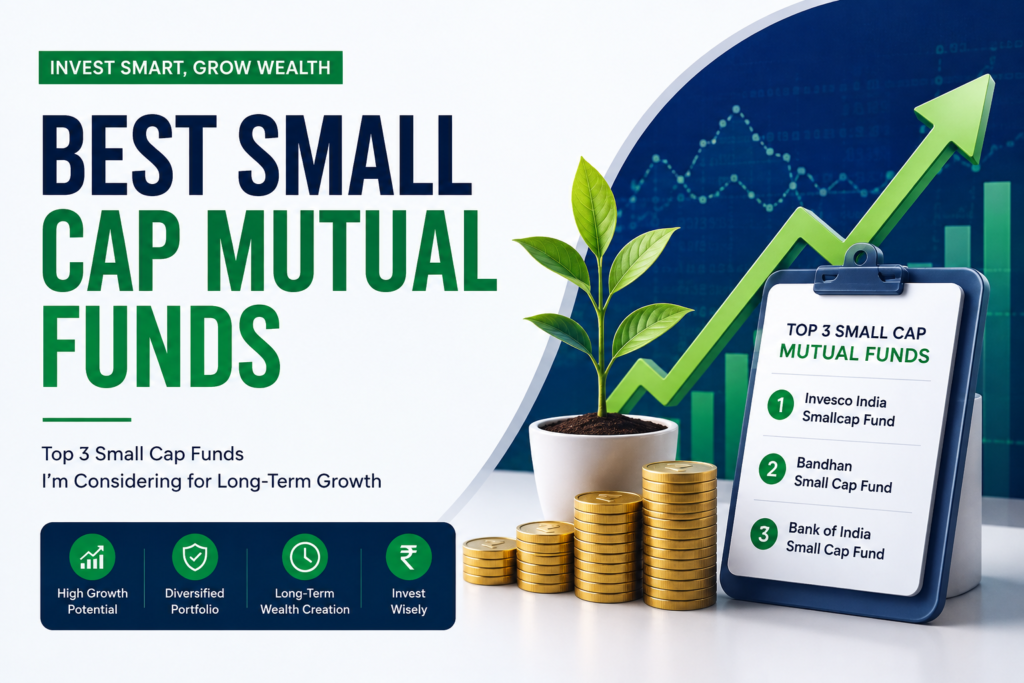
Based on my own research and experience, these are three small cap mutual funds I am currently considering:
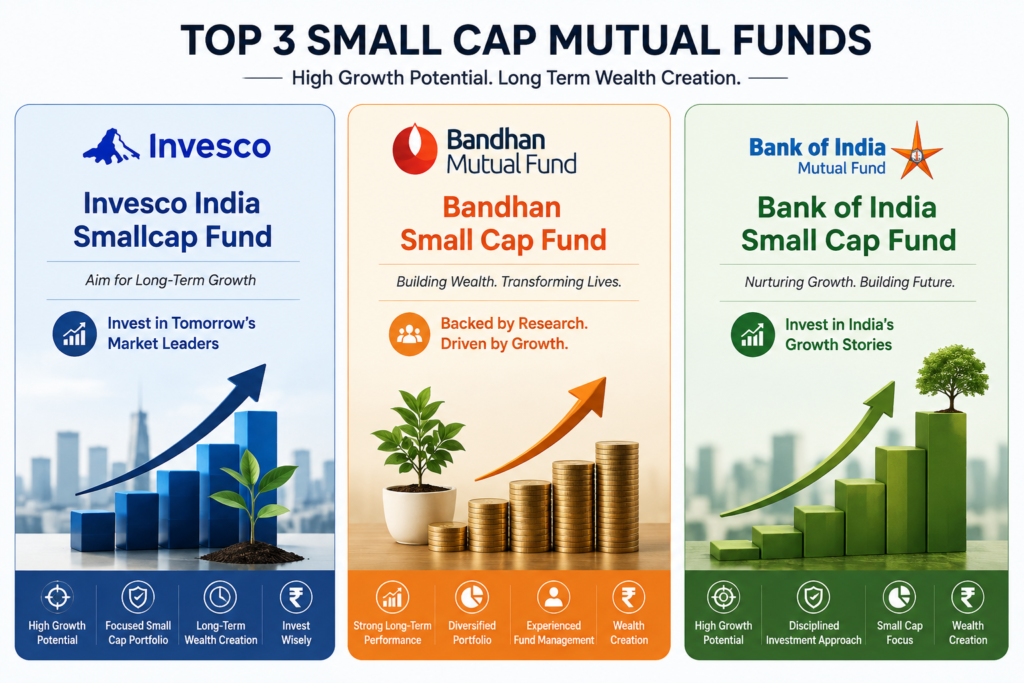
- Invesco India Smallcap Fund Direct Growth
- Bandhan Small Cap Fund Direct Growth
- Bank of India Small Cap Fund Direct Growth
Important: This is my personal research and not a recommendation to buy or sell any mutual fund. Mutual fund investments are subject to market risks. Always review the latest scheme documents and consider your own financial goals and risk tolerance before investing.
Quick Comparison
| Mutual Fund | 1-Year Return* | 3-Year Return* | Approx. AUM | Risk |
|---|---|---|---|---|
| Invesco India Smallcap Fund Direct Growth | 18.81% | 24.89% | ₹14,475 Cr | Very High |
| Bandhan Small Cap Fund Direct Growth | 14.44% | 27.22% | ₹31,103 Cr | Very High |
| Bank of India Small Cap Fund Direct Growth | 29.60% | 24.15% | ₹2,819 Cr | Very High |
*Returns and AUM can change with market conditions. Figures referenced from data available in August 2026.
1. Invesco India Smallcap Fund Direct Growth
The Invesco India Smallcap Fund Direct Growth is one of the funds I am considering for exposure to the small-cap segment.
According to currently available data, the fund has delivered approximately 18.81% annualised returns over 1 year and 24.89% over 3 years. Its fund size is around ₹14,475 crore.
One reason I find this fund interesting is its combination of an established fund house and a relatively large asset base.
Why I am considering it
- Strong historical performance over longer periods
- Large AUM
- Exposure to small-cap companies
- Direct Growth option
- Suitable for investors looking for long-term equity exposure
The fund should not, however, be viewed as a low-risk investment. Small-cap stocks can be highly volatile, and investors need to be comfortable with significant fluctuations in portfolio value.
The fund also has an exit-load structure where a 1% charge can apply to units above the specified threshold when redeemed within one year. Investors should check the latest scheme information before investing.
My view: I would consider Invesco India Smallcap Fund for investors who want long-term small-cap exposure and are comfortable with high volatility.
2. Bandhan Small Cap Fund Direct Growth
The Bandhan Small Cap Fund Direct Growth is another fund that stands out in my research.
The fund currently has an AUM of around ₹31,103 crore. Its reported annualised return is approximately 14.44% for 1 year, 27.22% for 3 years and 20.3% for 5 years based on currently available data.
The fund is classified as Very High Risk, which is normal for a small-cap equity fund.
Why I am considering it
- Large fund size
- Strong 3-year historical performance
- Diversified portfolio
- Direct Growth option
- Relatively low minimum SIP amount
The current minimum SIP amount shown is ₹100, which can make it accessible to investors who want to start with a relatively small monthly investment.
The fund’s current expense ratio is around 0.57%, according to the latest available Groww data.
There is also an exit load of 1% if units are redeemed within one year, subject to the scheme’s applicable conditions.
My view: Bandhan Small Cap Fund is interesting for investors who want a diversified small-cap fund with a relatively large asset base and strong historical 3-year performance.
3. Bank of India Small Cap Fund Direct Growth
The third fund on my list is the Bank of India Small Cap Fund Direct Growth.
This fund is particularly interesting because its recent and long-term historical performance has been competitive with the small-cap category.
Currently available data shows approximately 29.60% 1-year annualised returns, 24.15% 3-year returns and 21.37% 5-year returns. The fund’s AUM is around ₹2,819 crore.
The Bank of India Mutual Fund’s June 2026 factsheet reports a 23.51% 3-year return and 21.00% 5-year return for the Growth Option, compared with 19.60% and 16.80%, respectively, for the Nifty Smallcap 250 TRI benchmark.
Why I am considering it
- Strong historical returns
- Smaller AUM compared with some large small-cap funds
- Exposure predominantly to small-cap companies
- Long-term track record
- Direct Growth option
The March 2026 factsheet showed approximately 79.48% of the portfolio in small-cap companies, with additional exposure to mid-cap and other categories.
The current exit-load structure shown by Groww states that a 1% charge can apply to units in excess of 10% of the investment when redeemed within three months.
My view: Bank of India Small Cap Fund is worth researching if you are looking for a small-cap fund with strong historical performance and a smaller asset base.
Which Is the Best Small Cap Mutual Fund?
There is no single small-cap mutual fund that will be the best choice for every investor.
My three picks have different characteristics.
Invesco India Smallcap Fund
I would consider this if I wanted a combination of an established fund house, sizeable AUM and strong long-term performance.
Bandhan Small Cap Fund
I would consider this if I wanted a large, diversified small-cap fund with strong historical 3-year performance.
Bank of India Small Cap Fund
I would consider this if I wanted to explore a smaller fund with competitive historical returns.
The important point is that past returns should not be the only reason for choosing a mutual fund.
What Should You Check Before Investing in Small Cap Funds?
Before investing in any of the best small cap mutual funds, I would look at several factors.
1. Long-Term Performance
Don’t select a fund simply because it has generated high returns over the last 6 or 12 months.
Look at multiple periods such as:
- 1 year
- 3 years
- 5 years
- Since inception
Longer periods can provide a better picture of how a fund has performed through different market conditions.
2. Expense Ratio
The expense ratio is the cost charged by the mutual fund scheme for managing the investment.
All else being equal, a lower expense ratio can be beneficial because costs reduce the return available to investors.
However, you should not select a fund based solely on the lowest expense ratio.
3. Portfolio
Check what companies and sectors the fund owns.
A diversified portfolio can help reduce dependence on a small number of stocks or sectors, although it cannot eliminate market risk.
4. Fund Manager
The fund manager’s investment approach and experience can also be important.
However, you should avoid selecting a fund solely because of one fund manager, since fund management teams and investment strategies can change.
5. AUM
Assets Under Management, or AUM, tells you how much money is managed by the fund.
A larger AUM does not automatically mean a fund is better. It is simply one factor that can be considered alongside performance, portfolio construction and investment strategy.
Are Small Cap Mutual Funds Risky?
Yes.
Small-cap mutual funds are generally classified as Very High Risk because they invest predominantly in smaller companies whose stock prices can be more volatile.
During a market correction, small-cap funds can fall significantly.
Therefore, these funds may be more appropriate for investors who:
- Have a long investment horizon
- Can tolerate large temporary losses
- Understand equity-market volatility
- Do not need the money in the short term
- Are investing according to a suitable asset-allocation plan
If you may need your investment within a short period, a small-cap fund may not be appropriate for that goal.
Should You Invest Through SIP?
A SIP can be one way to invest in equity mutual funds gradually rather than investing a large amount at one time.
For example, an investor could choose a monthly SIP amount based on their income and financial goals.
However, a SIP does not eliminate the risk of losing money. The value of your investment can still fall when the underlying stocks decline.
The important thing is to choose an investment amount that you can continue comfortably through both rising and falling markets.
My Final Take
If I were researching the best small cap mutual funds, the three funds I would currently put on my research list are:
- Invesco India Smallcap Fund Direct Growth
- Bandhan Small Cap Fund Direct Growth
- Bank of India Small Cap Fund Direct Growth
All three have shown competitive historical performance, but they also carry Very High Risk.
I would not choose a fund simply because it delivered the highest return in a particular year. Instead, I would compare its long-term performance, portfolio, expense ratio, fund manager, AUM and risk before making an investment decision.
Most importantly, past performance does not guarantee future returns.
If you are new to mutual funds, consider speaking with a SEBI-registered investment adviser before investing.
Frequently Asked Questions
Which are the best small cap mutual funds?
Some small-cap funds investors may research include Invesco India Smallcap Fund Direct Growth, Bandhan Small Cap Fund Direct Growth and Bank of India Small Cap Fund Direct Growth. However, the right fund depends on your goals, time horizon and risk tolerance.
Are small cap mutual funds good for long-term investment?
Small-cap funds can provide long-term growth potential, but they also carry very high risk. They are generally better suited to investors who can tolerate substantial volatility and remain invested for the long term.
Can I invest in small cap mutual funds through SIP?
Yes. Small-cap mutual funds generally offer SIP investment options. The minimum SIP amount varies by scheme.
Are small cap mutual funds risky?
Yes. Small-cap mutual funds are classified as Very High Risk because they invest predominantly in small-cap stocks.
Should I invest in one or multiple small cap funds?
Investing in multiple small-cap funds does not automatically mean you have better diversification because different funds may hold many of the same stocks. Compare their portfolios before deciding.
Which is better: SIP or lump sum in a small cap fund?
There is no universally better option. SIP allows you to invest periodically, while lump-sum investing puts a larger amount into the market at once. Your choice should depend on your financial situation, investment horizon and risk tolerance.
Disclaimer
This article is for educational and informational purposes only and should not be considered investment advice or a recommendation to buy or sell any mutual fund. Mutual fund investments are subject to market risks. Investors should read the scheme-related documents carefully and consider consulting a qualified financial adviser before investing.
Data note: Mutual fund NAVs, AUM, expense ratios and returns change over time. The figures in this article are based on sources available in August 2026 and should be verified against the latest AMC/fund documents before making an investment decision.