AI tools are everywhere right now. Every week there’s a new update, a new model, and a new “best AI.”
So where does Anthropic’s Claude AI actually stand?
Is it better than OpenAI?
Is it safer?
Is it good for business use?
Let’s break it down clearly — and I’ll include official references for every major point so you can verify everything yourself.
What Is Anthropic?
Anthropic is an AI research company founded in 2021 by former OpenAI researchers, including Dario Amodei and Daniela Amodei. The company focuses heavily on AI safety and alignment.
🔗 Official Website:
https://www.anthropic.com
🔗 Company Page:
https://www.anthropic.com/company
Their main AI product is called Claude.
What Is Claude AI?
Claude is Anthropic’s family of large language models (LLMs) designed for:
- Writing and content generation
- Code assistance
- Document summarization
- Customer support automation
- Enterprise AI applications
🔗 Claude Overview:
https://www.anthropic.com/claude
Constitutional AI – What Makes Claude Different
Anthropic developed a training method called Constitutional AI.
Instead of relying only on human feedback, Claude is trained using a defined set of principles (a “constitution”) to guide its behavior. This is designed to improve safety and alignment.
🔗 Research Paper (Constitutional AI):
https://arxiv.org/abs/2212.08073
🔗 Anthropic Research Page:
https://www.anthropic.com/research
For businesses, this matters because it may reduce harmful or risky outputs.
Claude 3 Model Versions (Haiku, Sonnet, Opus)
Anthropic introduced the Claude 3 family with three model tiers:
🔹 Claude 3 Haiku
- Fast and cost-efficient
- Designed for lightweight tasks and automation
🔹 Claude 3 Sonnet
- Balanced performance
- Good for business and content workflows
🔹 Claude 3 Opus
- Most advanced reasoning
- Designed for complex analysis
🔗 Claude 3 Announcement:
https://www.anthropic.com/news/claude-3-family
Large Context Window (Handles Long Documents)
Claude models are known for supporting very large context windows, allowing them to process long documents and large codebases.
This makes them suitable for:
- Contract analysis
- Research papers
- Technical documentation
- Knowledge base processing
🔗 Claude Documentation (Context & API):
https://docs.anthropic.com
Enterprise API & Developer Features
Anthropic provides API access for developers and businesses.
Features include:
- Structured outputs
- Tool use
- System prompts
- Model configuration
- Enterprise deployment options
🔗 API Documentation:
https://docs.anthropic.com/en/api
Safety & Alignment Focus
Anthropic positions safety as a core priority in model development.
They publish safety and alignment research publicly.
🔗 Anthropic Safety & Research:
https://www.anthropic.com/research
Pricing Overview
Claude uses token-based pricing depending on:
- Model type
- Input tokens
- Output tokens
🔗 Official Pricing Page:
https://www.anthropic.com/pricing
Always check the pricing page directly because rates may change.
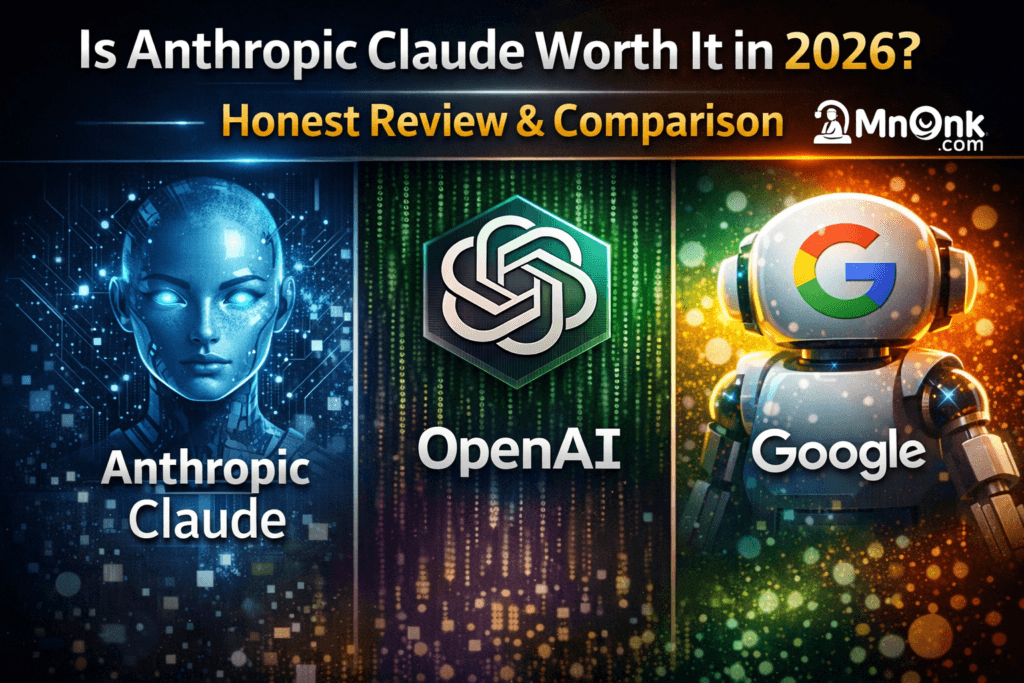
How Claude Compares to OpenAI and Google
While Anthropic focuses strongly on safety and enterprise alignment, OpenAI and Google have broader ecosystems.
🔗 OpenAI Official Website:
https://openai.com
🔗 Google Gemini Overview:
https://deepmind.google/technologies/gemini/
Each platform has strengths depending on your use case.
Final Thoughts
Claude is positioned as a business-focused, safety-oriented AI system with strong document handling capabilities and enterprise-ready APIs.
If your priority is:
- Long document processing
- AI alignment and safety research backing
- Structured business use
Claude is worth evaluating.
If your priority is:
- Ecosystem size
- Broad integrations
- Consumer-level experimentation
You may also compare OpenAI or Google.